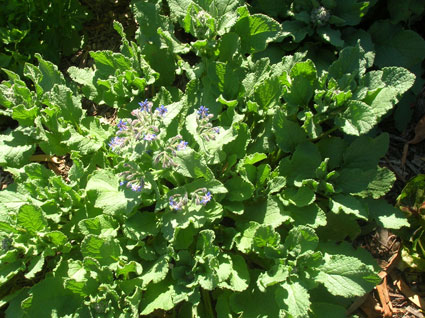
Borage / Borago officinalis
Boraginaceae
Borago
officinalis
Bugloss, Burrage, Herb of Gladness.
Adrenal stimulant, aperient, demulcent, diaphoretic, diuretic, febrifuge, expectorant, galactagogue, emollient, pectoral, refrigerant, tonic.
Leaves, flowers, seeds.
Pyrrolizidine alkaloids (lycopsamine, intermedine and acetyl derivatives), amabiline, supinine, choline, saponins, mucilage, tannins, Rosmarinic acid, silicic acid, calcium, potassium, Iron, magnesium, manganese, phosphorous, sodium, zinc, Vitamins - A, B2, B3, B5, B6, B12, C. GLA in the seeds. Beta carotene, selenium.
Borage stimulates the adrenal glands and encourages the production of adrenaline. It is also useful as a tonic for anyone suffering from adrenal exhaustion, or excess stress. It can also counter the effects of steroid therapy. It can be used for fevers, the early feverish states of pleurisy and whooping cough and pulmonary disease. The tea is used for rheumatism and stimulating milk flow for breast feeding. Borage seeds contain gamma linoleic acid as does Evening Primrose oil but Borage seeds have higher levels. Borage, through its affect on the adrenal glands, has shown to affect the sex hormones which stimulate the ovaries and testes. The febrifuge action makes it a useful remedy for colds and flu. The flowers make a very good syrup for coughs and also a good addition to salads and summer drinks. The high mucilage content helps soothe respiratory problems. Borage seed oil is used to treat pre-menstrual complaints, eczema, other chronic skin problems and rheumatic problems. There is some controversy about the presence of pyrrolizidine alkaloids as there is with Comfrey.Borage has been made a Schedule 9 drug in Australia , in the same category as Heroin, etc. It can not be prescribed for internal use by a practitioner. What you choose to do with it is an entirely different matter.
https://www.theherbalist.com.au/herb_gallery/borage